
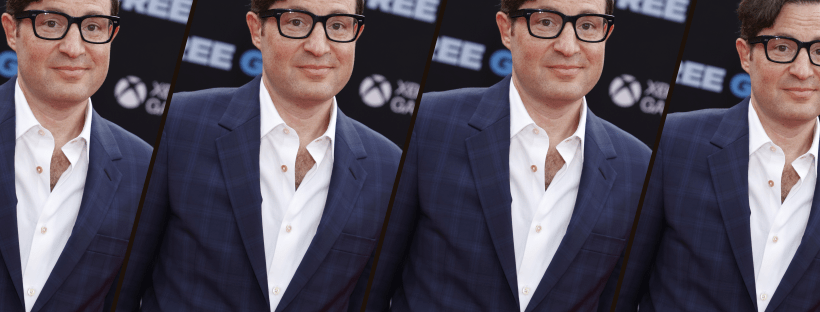
Recently, I sat down with long-time member Matt Lieberman to chat about his writing process and what it’s like to write for iconic characters. Matt has written a number of films including Free Guy (2021) and The Christmas Chronicles (2018). Catch his latest film, The SpongeBob Movie: Search for SquarePants while it is still in theaters!
Let’s start at the beginning and tell me about what sparked your love for writing?
For me, it started in high school. I was always into creative writing. But even as film became a passion for me, I never really considered screenwriting for some reason. It never even occurred to me in my high school mentality that it was a viable career path. It wasn’t until I was in film school that I realized I could create movies, in a way, without having ask favors to get them made.
You know, when I chat with writers, I hear that so often. Like, “I loved stories but never considered it as a career.” So many writers seem to start in that place where it doesn’t click until, one day, it just does.
Especially if you don’t live in LA! My daughter, who is growing up here, sees getting a job in entertainment as totally normal, so it is different for her. When I was growing up, it was nowhere on anyone’s radar that you could make a living from this.
So, the interest in writing started in high school. When did you really start learning and going after it?
I took creative writing courses in high school and college. There were certain writing teachers that really motivated me. And philosophy teachers too. Writing for those classes really inspired me. And then I took a ‘Feature Screenwriting’ course where, over the summer, you had to come in with an idea and an outline and be ready to go on day one. I came in ready and I was the only one in the whole class who was prepared. No one else had taken the requirement seriously. I’m such a rule follower! But my teacher took me under his wing because he was like, “Oh! This kid is actually interested.” So, he really helped me.
Sounds like he became a mentor to you.
Yeah! I finished my first screenplay and he gave me contact information for some agents and told me how to write a query letter. Which you had to physically write by hand and send in the mail. And that gave me the tools I needed when I moved out here. And then I kept writing new scripts and submitting to agents until I got representation.
Switching gears a little bit: The SpongeBob Movie: Search for SquarePants, your latest film, is part of a huge, massive franchise. But you’ve also done work with other huge franchises like The Addams Family and Scooby Doo. What is it like to write for characters that are already so known and so loved?
There is something really fun about those kinds of characters. Especially if you’re already familiar with them. And so far, I’ve only worked with IP I’m familiar with. I haven’t been involved with any project that I wasn’t some sort of a fan of at some point in my life.
Is that intentional on your part?
Well, I can’t think of anything big I passed on because I wasn’t familiar with it. But I probably have. And yeah, I definitely watched a lot of Scooby Doo when I was growing up. And when I got that project, I remember thinking, “I can’t believe they just gave me the keys to this car!” When the characters are so iconic, they’re in your DNA. It makes it easier in some ways. I absolutely have a certain respect for canon, but you can’t get caught up with it to the detriment of a great story. You need to ask yourself, how am I making this fresh while keeping the original voice of the material and making the best story I can.
Yeah! That makes perfect sense. With SpongeBob, I think there are sixteen seasons of the show. All of these properties have a ridiculous amount of existing content. I feel like I would have been terrified to approach that, just because there is so much.
For Search for SquarePants, the movie that just came out, I was brought on while it was deep into production to work on story and character stuff. There is a SpongeBob brain trust that is very involved and protective, rightfully so. But there are big differences between the eleven-minute stories that make the show great and a feature length film. There are certain elements that must be there to keep people engaged for an hour and twenty minutes.
I remember, when I was growing up during the SpongeBob show’s heyday, so many kids weren’t allowed to watch it because parents thought it was rotting our brains. Is that sentiment still around? Have you encountered that?
It’s interesting that you mentioned that because that’s how my mom felt about Scooby Doo, that it would rot my brain. I feel vindicated that all that TV watching actually ended up helping me in my life! But with SpongeBob, it’s Paramount’s biggest brand! There is an irreverent but endearing quality to the world that’s kept people coming back for all these years. I mean, nobody watches SpongeBob to learn something, but that doesn’t mean it’s rotting your brain. There’s an escapism and cathartic release to comedy, especially silly, irreverent comedy!
We’ve talked about writing for these franchises. But you’ve also written quite a few original scripts. How do these two different worlds compare?
My career has been forged and paved by spec scripts. It’s my biggest recommendation to any aspiring writer. Of course, it’s fun to work on open writing assignments. And a lot of times, it is much easier to show up and tell other people what is wrong with their story. But you need to find your voice. Make an artistic statement. Bring something new and fresh into the world. I love to create stories out of the ether. To take the ideas in my head and get them out there. After they’ve been written, who knows what will happen with them? But it’s about honing your artistic perspective. Spec scripts show how you are different than the million other writers out there. And I’m an idea guy. A high-concept guy. Whether I’m writing a spec or pitching on an established piece of IP, I’m always thinking, “What’s the hook? What’s the idea that’s going to get somebody to want to see and hopefully care about this movie?” That’s what I’m always thinking about. And I get a huge adrenaline rush when it all comes together.
Pretty much everything you’ve written is a “family adventure.” Is there something about that genre that you are particularly attracted to?
My wheelhouse is big, popcorn four quadrant movies. And that’s usually where those films live. I signed with my manager, Adam Kolbrenner, a long time ago, and his philosophy was to focus on what you do best first. Once you find success, you can expand from there. For lack of a better word, you need to pigeonhole yourself when you’re just getting started. Otherwise, buyers, producers, and executives won’t know what to make of you. So, it’s the genre my sensibility originally gravitated towards. Then I got an overall deal at Disney as part of their (no defunct) feature writer’s program, which was a great thing for my career, and planted me firmly in that world.
Tell me about your process. From concepts through to the final draft. What is your method for building a story?
I’m always looking for the big idea. What is the fresh take? What is the shiny new idea I want to see on screen? And from there, the best way to battle test the concept is to ask yourself two things: is there an ironic hook and is it about something? Do those elements fit together in an organic way? Free Guy is a great example of that because it’s a lens shift story where the background guy forges his way through a violent, chaotic world to become the main character in his own life. And there is an organic thematic in that. It’s a story about free will. And once those elements are locked in, it’s easier (and fun!) to build out the characters and situations from there. After I am excited about a new idea, I’ll sometimes outline the major beats, or sometimes I just charge right into the story and see where it takes me. I’ve done it every single way, and I don’t have one preferred modality. Once you get the first draft down, you begin rewriting from there — and that is usually the most challenging part of the process.
That is so great to hear! Because I frequently feel guilty for not outlining.
Oh no! Some big writers and filmmakers have told me they don’t outline. Like Chris Columbus once told me that if he plans it out too much in advance, he loses a bit of the discovery of the storytelling. Of course, you should have an idea of where you’re going but doing a big, detailed outline can potentially spoil some of the surprise and adventure. Unless you’re crafting some sort of elaborate mystery or complicated concept, I don’t think it’s always necessary. And sometimes, I write pages faster than I can outline!
Yes, a lot of the time it’s just better to go with the idea and see where it takes you.
Yeah, I’m in the middle of an outline right now and it’s rough. Even at this point in my career, I overcompensate in the treatment stage. I put too much story into the outline. Once I get to the draft I realize, “I don’t need any of this!” But a lot of the time, you don’t know what’s important until you’re walking around and talking through the characters and really feeling the scenes. Sometimes the work is about getting out of your own way, throwing up everything onto the page and reassessing from there. Perfect is the enemy of good. That kind of stuff.
We already touched on this a bit, but what advice do you have for aspiring writers?
Always be working on the next project. Don’t put all your eggs into one basket because everything takes way longer than you ever imagined. Even under the best scenarios. Don’t wait around for anybody or anything. Don’t let yourself get caught up in the moves of the industry. If someone told you the odds of becoming a successful screenwriter, no rational person would ever do it. So just tune out the noise, try telling the best stories, the way that only you can tell them, and you’ll find your way.

 theOFFICE